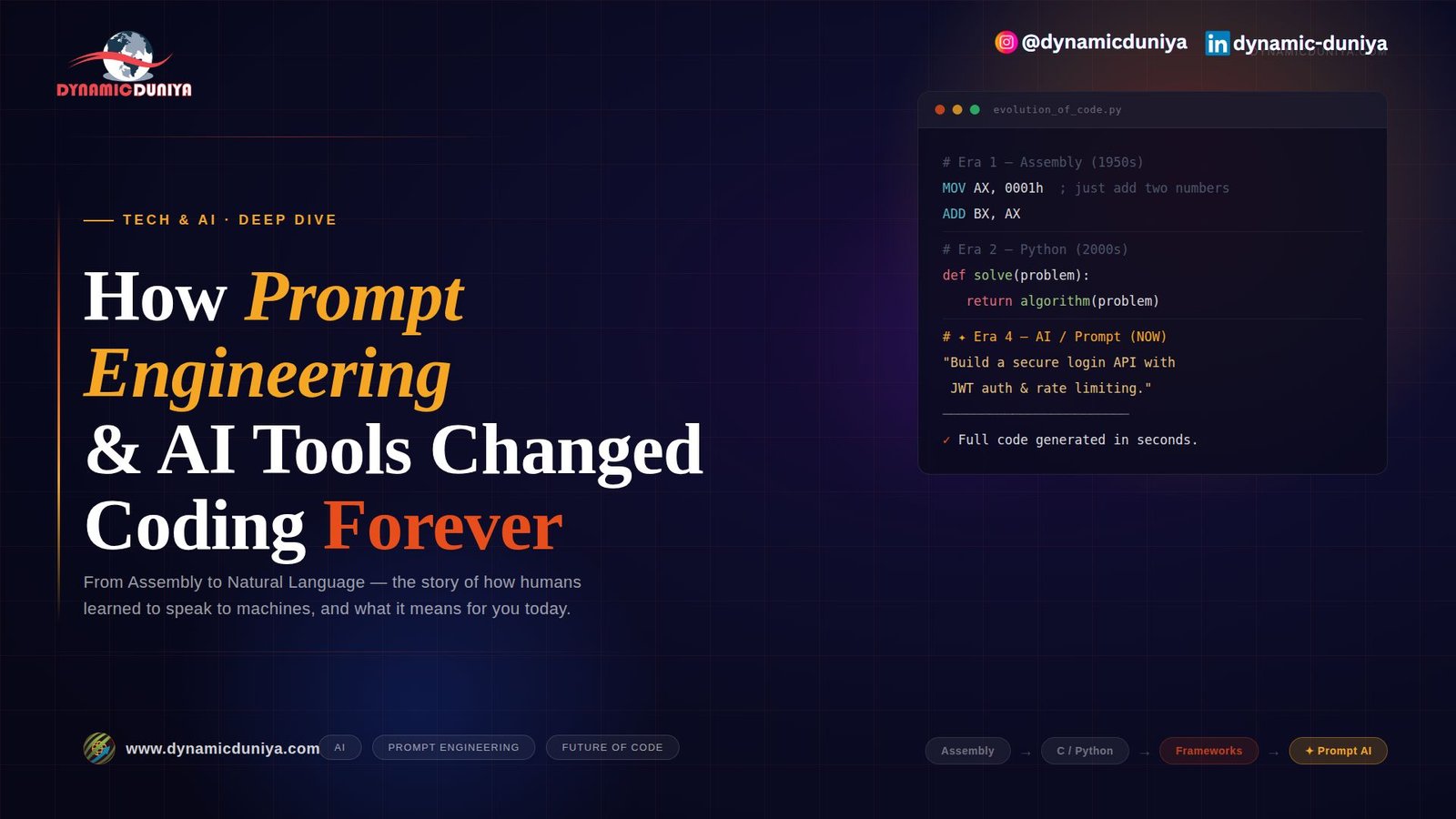
From punching cards with binary zeros and ones, to typing in plain English and watching machines build software — the story of coding is the story of humanity constantly finding smarter shortcuts. Here's the full journey, and why what's happening right now is unlike anything before.
Let me ask you something. Imagine you had to build a house — but instead of calling an architect, you personally had to lay every single brick, wire every circuit, and weld every pipe yourself. That's what early computer programming felt like. Every instruction. Every memory address. Every single bit.
Now fast forward to today. You open a laptop, type a sentence in plain English, and a fully working application starts building itself in front of your eyes. Wild, right? But this didn't happen overnight. This is a story that's been unfolding for over 70 years — and we're living right in the middle of its most dramatic chapter.
In the very beginning of computing, humans didn't instruct machines in words. They spoke machine — literally. Assembly language was a thin layer over pure binary: ones and zeros. Every single operation had to be spelled out at the lowest possible level.
That's just adding two numbers. Imagine building a full application this way. The programmers of that era were essentially translators — converting human logic into the cold, mechanical language of the machine. They were brilliant, yes. But the barrier to entry was impossibly high.
Only a handful of people on the planet could do this work. And it took months to write what we'd now call a "simple program." But those pioneers laid the foundation for everything that followed.
Then came C, and later C++. A huge leap. You could now write code that was far closer to human logic — but underneath it all, you were still very much managing memory, pointers, and hardware directly. The machine still demanded precision.
C and C++ gave programmers enormous power. Operating systems, browsers, game engines — all built with these languages. But that power came with responsibility. A single misplaced pointer, a memory leak, an off-by-one error — and the whole thing crashes. Sometimes catastrophically.
This era created the mystique of the "programmer as wizard" — someone who spent years mastering arcane syntax, debugging at 2 AM, understanding how RAM works at a fundamental level. Respect to those people. They deserve every bit of it.
Then the world got smarter about this. Python arrived with a radical idea: code should read almost like English. Java brought "write once, run anywhere." PHP let ordinary people build websites without a computer science degree. The barriers were falling — slowly, but surely.
Millions of new people entered the world of programming. Not just computer scientists, but designers, biologists, economists, journalists — anyone with a problem they wanted to solve. Python especially became the language of data science, machine learning, web development, automation.
But here's the thing — even Python requires you to learn. You still need to understand loops, functions, data structures, APIs, frameworks, databases. The barrier got lower, but it didn't disappear. Learning to code still took months, often years, of serious dedication.
And now we're here. Right now. In the middle of arguably the biggest shift in the history of computing. And the new language? It's yours already. You've been speaking it your whole life.
It's called human language.
We don't need to learn Assembly. We don't need to memorise Python syntax. We type a clear, thoughtful description of what we want — and the machine figures out the rest. This isn't science fiction. This is Tuesday morning in 2026.
Think about that for a moment. What would have taken a senior developer a week of solid work — architecture decisions, syntax, debugging, documentation — now takes a well-crafted paragraph. The skill has shifted from knowing how to write code to knowing how to describe what you want clearly and precisely.
That is Prompt Engineering. And yes — it is absolutely a skill. A serious one. The people who are great at it can build things that would have been impossible for small teams just five years ago.
Here's where I need to be very clear, because I see this misconception everywhere: No. Programming languages are not dying. Not even close.
What's happening is something far more interesting. AI tools are built entirely on top of Python, C++, Rust, Go, TypeScript. Every large language model, every AI server, every vector database — pure traditional code underneath. Someone has to write that code. Actually, a lot of highly skilled people do.
The Real Picture
AI is not replacing programming languages — it's creating two distinct tiers. A new tier of people who build with prompts (that's most of us now), and a deeper tier of engineers who build the AI systems themselves. Both matter. Both are in demand.
Think of it this way. When calculators were invented, mathematicians didn't disappear. They went deeper — tackling problems that the calculator enabled them to even consider. The same thing is happening in software right now.
The advanced coders of today are working on AI agents, custom security systems, distributed infrastructure, model fine-tuning, real-time processing engines. They use AI tools in their daily work too — but their deep knowledge of the underlying systems is what makes them irreplaceable. AI is their power tool, not their replacement.
Humans spoke directly to the machine in its own language. Binary and low-level assembly. Only a tiny elite could do it. But they built the foundation of everything.
High-level but still close to the metal. Enormous power, enormous responsibility. The age of the professional programmer as a rare specialist.
Abstraction accelerated. Millions joined the coding world. Frameworks, libraries, and the internet made software accessible to a far wider audience.
The newest layer. Human language itself becomes a programming interface. AI interprets intent, writes code, manages servers, builds agents. The most inclusive era yet — and the most powerful.
I'm going to be direct with you, because I think it matters.
If you are not using AI tools in your daily work today — whether you're a developer, a designer, a marketer, a business owner, a student — you are already falling behind. Not because you're less intelligent. Not because you lack talent. Simply because someone else with the same talent is doing ten times as much in the same hours, using tools you haven't picked up yet.
This is real, not hype
It won't be AI that takes your job. It will be a person who knows how to use AI well who takes your job. The tool is already here. The question is whether you're going to use it.
The good news? The barrier to entry has never been lower. You already speak the new programming language. You're using it right now — it's just English (or Hindi, or any language you think in). The craft is in learning to describe your intentions with clarity and precision. That's it. That's the core skill.
Start with the problem you have today. Not a hypothetical future problem. Today's actual problem. Ask an AI to help you solve it. See what comes back. Iterate. Learn. Build. The best way to learn this language, like every language before it, is to use it.
From binary to Assembly, to C, to Python, to natural language — every era of coding has been about making human intention clearer to machines. We've been on this journey for 80 years. AI is not the end of that journey. It's the most exciting leg of it yet.
Use AI as your partner, your co-pilot, your accelerator. Not as a threat. Not as a crutch either — learn how it works, push its limits, understand its edges. But above all, use it. Every single day. Build things you couldn't have built before. Solve problems faster than ever. That's the opportunity sitting in front of you right now.
Don't fear AI — become it
Sign in to join the discussion and post comments.
Sign in